


From flat whites in London to espressos in Rome and café con leche in Madrid, Europeans have been staunch coffee drinkers since the seventeenth century. Today, Europe is the world’s largest coffee market, accounting for roughly one-third of coffee consumption on the planet.
Cafés have long served as cultural meeting points, and the rise in popularity of specialty coffee since the turn of the millennium has marked the drink as a ritual and a daily treat.
But in recent years, a subtle shift has emerged; Gen Z and health-conscious millennials are starting to rethink what they drink, where it comes from, and how it fits into their daily lives.
The trend for “instagrammable” matcha lattes is perhaps the most visible shift away from coffee, but the market for caffeine alternatives is projected to grow steadily from $1.4 billion USD (€1.19 billion) in 2025 to reach nearly $2.92 billion USD (€2.48 billion) by 2034.
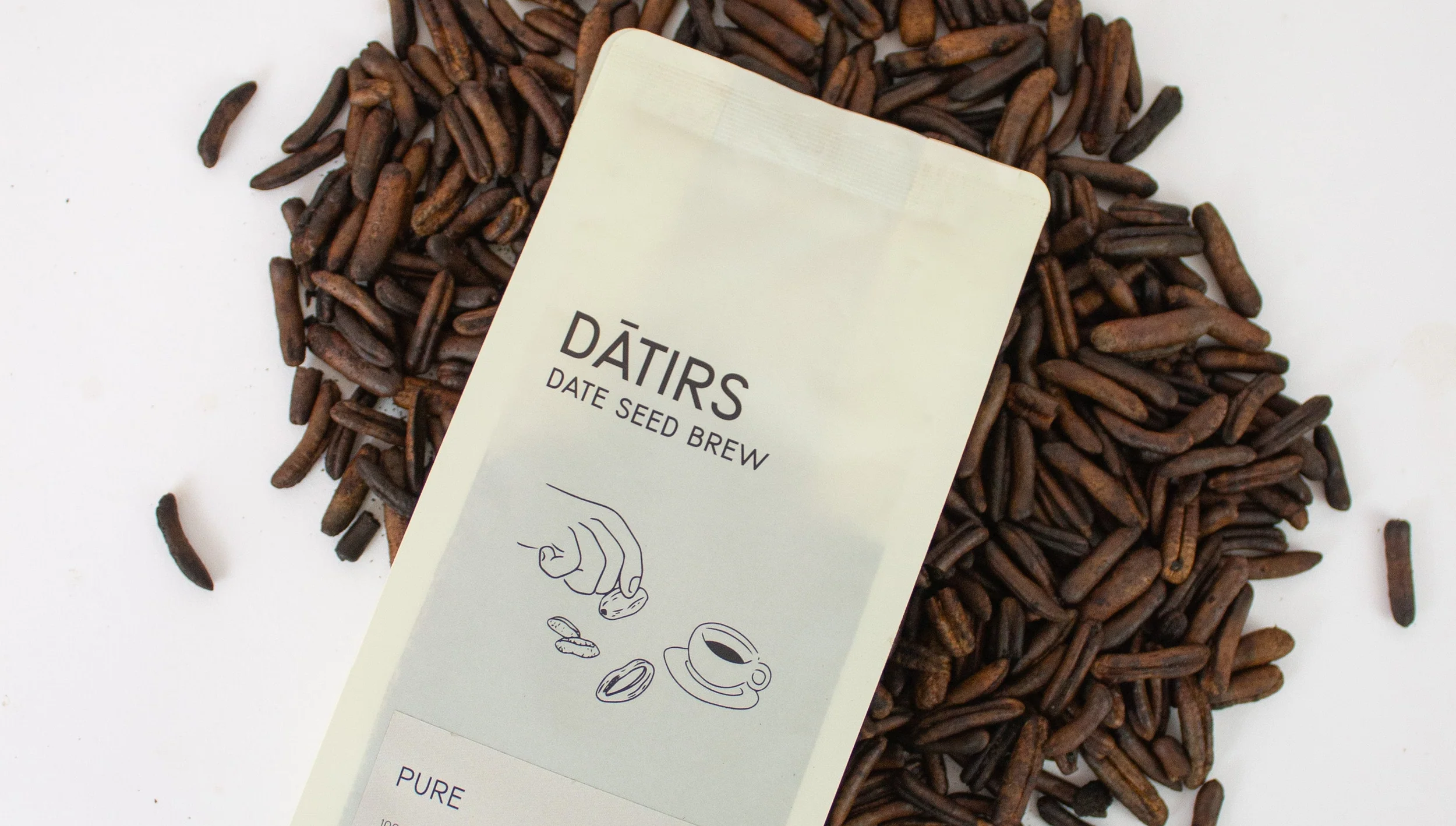
Enter Barcelona-based Datirs: the naturally caffeine-free drink, made from roasted date seeds, aims to bridge the gap between flavour and daily ritual while appealing to consumers who prize health, wellness and balanced energy.
Novobrief spoke with Mostafa Shokry, Datirs co-founder, and sustainability facilitator Ombeline Dequidt about the beginnings of the date seed brew brand, and what they hope the startup will achieve over the next five years.
A lightbulb moment
“It was like a lightbulb moment.” Shokry explained. “My father had done a PhD on the effect of dates on the body, and one special section was about the date seed and how useful it is for the body, for the kidneys and liver and everything.”
The founder clapped his hands together as he recalled the inspiring moment. “And so I said, let’s make it!”
What began as research into a largely discarded part of the date fruit has evolved into a drink designed to be savoured. Rather than positioning itself as a substitute, Datirs invites customers to enjoy the shared experience of long-defined coffee and tea culture, but with added health benefits—and without the caffeine crash.
The focus on wellness is a core part of the date seed brew’s appeal; Dequidt, who is also a member of the Datirs team, explains:
“It’s important for me to know what I’m putting in my body. If you’re drinking Datirs, it’s good for your body, it’s good for your health, and it gives you energy.”
The drink meets a growing demand for functional beverages that offer mental clarity, sustained energy, and nutrition without relying on caffeine, sugar, or artificial ingredients–reflecting a clear shift towards a more intentional consumption.
Conscious choices
Sustainability is a key factor for today’s consumers, and Datirs is well-positioned as a green alternative. By using date seeds that would otherwise go to waste, the brew is designed to resonate with a generation that values transparency, ethics, and environmental responsibility.
Meanwhile, the effects of climate change are beginning to bite. A drought in Vietnam, the world’s second-largest coffee producer, cut yields by roughly 20% across the 2023/24 and 2024/25 seasons, tightening global supply and pushing prices higher. Coffee itself also contributes to the problem—perhaps surprisingly, the product comes ahead of poultry and pork in terms of carbon footprint.
Conversely, Matcha, which continues to grow in popularity as its consumption skyrockets in the West, also faces its own climate challenges; while the crop generally has a much lower carbon footprint than coffee, it is reliant on sensitive conditions and requires careful cultivation. Combined with rising global demand, these fragile production conditions have put farmers under pressure, with the corresponding effect on consumer wallets.
What’s brewing next
When asked what the future holds for Datirs, Shokry was clear: “I imagine Datirs to be available throughout Europe, and to come in different flavours—we’re working on flavours like cinnamon and chocolate.”
The founder stressed that Datirs will be sold in cafés rather than be positioned solely as a retail product; as coffee prices fluctuate and margins tighten, alternatives that offer stability in sourcing and cost are becoming increasingly appealing to café owners.
In this sense, Datirs is not competing with coffee as much as complementing it—offering cafés a way to future-proof their menus, appeal to caffeine-averse customers, and diversify.
Savouring the moment
Aside from wellness and sustainability, Shokry and Dequidt are keenly aware of the importance of ritual and community. When asked about what they most enjoy about café culture, Dequidt explained:
“It’s about the ritual of meeting people and having a drink together.” Shokry agreed. “For me it’s all about the social aspect, the community aspect”.
The focus on ritual, shared moments, and taking time to slow down reflects a broader pushback against hyper-productivity and hustle culture. In cafés, ordering a drink is often an excuse to linger, catch up with friends, or mark a moment in your daily routine; connection doesn’t come from caffeine.
The next generation of café culture
Datirs’ timing is spot on. After decades of growth, specialty coffee seems to have saturated the market. Publications like Perfect Daily Grind highlight stagnating expansion in mature markets, with cafés proliferating in European cities despite facing tighter margins and rising costs.
At the same time, consumer expectations are shifting toward transparency, wellbeing, and sustainability–all areas where Datirs thrives.
Whether date seed brews will become as ubiquitous as milk alternatives once did in their rise against dairy remains to be seen. But, as Europe’s relationship with coffee evolves, the future of café culture will certainly be defined by adaptability, sustainability, and a more thoughtful approach.
Featured image: Via Datirs.